

Florence Leather Guide: The Real Artisans Worth Finding
Ancient workshops, family botteghe and the makers keeping genuine Florentine leather alive — an insider's guide to the artisans worth seeking out.

Pelleteria Viviani, Florence. Pelleteria Viviani Image.
By Ana Ka · Ana's Secret Guide to Italy
Published March 22, 2026 · Last updated June 22, 2026
Florence has been synonymous with leather for centuries — and the tradition is still very much alive, if you know where to look. The street markets and tourist-facing shops tell one story. This guide tells another.
Most of what you will find at San Lorenzo market and the stalls around Mercato Nuovo is not what it appears to be. The items are assembled in Italy and carry a Made in Italy label — but the material is often pelle soffiata, a processed expanded leather that does not breathe, does not age, and will never develop the patina that real Tuscan leather acquires over years of use. For the full story on how to tell the difference — including what to look for, what to avoid, and the truth about leather jackets — see our dedicated guide: How to Spot Real Leather in Florence.
If you want the genuine article — vegetable-tanned Tuscan leather, cut and stitched by hand in a real workshop — Florence still has it. These are the people who make it.
Why Florentine Leather Matters
Florence's leather tradition dates to the medieval guild of tanners and leather workers, one of the most powerful trade guilds in the city. By the Renaissance, Florentine vegetable tanning — using oak bark and natural plant extracts — had become a byword for quality across Europe. What survived into the 20th century was a dense network of small family botteghe, each specialising in a particular craft: bags, belts, boxes, book bindings, moulded coin purses. Many are now in their third or fourth generation. A few are in their first, run by designers who came to Florence specifically to learn this tradition and carry it forward. These are the makers worth finding.
Here are the Florence leather artisans I recommend — genuine craftspeople making vegetable-tanned, handmade leather goods in their own workshops in the city.
Florence Artisans Still Working by Hand
These are the workshops I recommend — family botteghe, independent makers and designer artisans who have chosen to keep working by hand, in their own spaces, at their own pace. Each one makes something genuinely worth owning.
Clamori di Firenze
Located at Via Porta Rossa, 72r.
A family workshop active since the 1950s, now run by the founder's descendants, who still design and make everything themselves following their grandfather's craft rules. Women's and men's bags for everyday and travel, all handmade in small production runs from Tuscan leathers. They follow fashion shapes and colours but keep production genuinely local — real Florentine workshop quality with friendlier, less intimidating prices than the luxury names, and a single unique shop in the world. The kind of place that makes you understand why people come back to Florence specifically to shop here. Bags typically in the mid-hundreds rather than four figures.
For current hours, visit the official Clamori shop website.

Clamori, Florence. Clamori Image.
GF89 — Giuseppe Fanara
Located at Via Palazzuolo, 136r.
Giuseppe Fanara left school at sixteen in 1979 and walked into a leather workshop near his house, where a local artisan passed the craft and its traditions on to him. He has been doing this work ever since — first for others, then from 1989 in his own bottega, now together with his son Mirko. After more than thirty-five years at the bench, he was awarded the Master Artisan certificate by the Chamber of Commerce of Florence and the Region of Tuscany.
His work is small in scale and extraordinary in finish. Coin purses, glasses cases, pen cases, cardholders and leather boxes — all made from cuoietto fiorentino, a vegetable-tanned leather certified by the Genuine Italian Vegetable Tanned Leather Consortium, using a tanning technique said to have been developed by the friars of Santa Croce in the 13th century. Every piece is round and smooth, with no sharp corners, no rough edges — soft, seamless and finished with a care that is immediately evident when you hold one. As Giuseppe puts it: the fact that something is handmade, well made and well finished matters more than its design. That philosophy shows.
His work has taken him to Japan multiple times for the Festa Italiana fair at Hankyu Department Stores in Osaka — where clients return year after year, sometimes after a gap of several years, which says everything about the lasting quality of what he makes. Prices are accessible — deliberately so. Giuseppe has always believed that genuine craft should not be out of reach. Small items from around €40; belts and small bags from €120.
For current hours, visit the official Giuseppe Fanara workshop website.

GF89 — Giuseppe Fanara, Florence. GF89 Image.
Furò e Punteruolo — Paolo & Luisa Fattori
Located at Via del Giglio, 29r.
Paolo Fattori was a truck driver who wanted to quit smoking cigarettes and switched to pipe tobacco — only to find that the tobacco dried out too quickly in its paper packet. One day he spotted a leather tobacco pouch in a shop window, drove straight to a leather supplier, bought what he needed, and spent his evenings after work cutting and sewing his own. A client saw it during a delivery, ordered one on the spot, and invited him to a craft market in Piazza delle Bigonge in Prato. That was June 2009.
.jpg)
Furò e Punteruolo, Florence. Furò e Punteruolo Image.
For four years Paolo drove his truck by day and cut leather by night, selling at markets across Tuscany — Prato, Florence, Lucca, Siena, San Gimignano. When he saw how much people loved what he made, he opened his own workshop in the centre of Florence on 2 March 2014. Luisa joined him, and today the two of them make everything themselves — belts, wallets, cardholders, bucket bags and laptop bags — each piece cut from vegetable-tanned leather with natural colours and no chemical treatments, hand-stitched with needle and thread. Most of the tools in the workshop Paolo made himself.
Visitors regularly stop to watch him cut a belt or stitch a bag in front of them. Some ask for his autograph inside their purchase. That is the kind of workshop this is.
Featured by many reputable local publications among Florence's finest artisans — as one of sixty makers representing the best of the city's living craft tradition. Belts and small goods from €60; bags from €220.
For current hours, visit the official Furò e Punteruolo workshop website.

Furò e Punteruolo, Florence. Furò e Punteruolo Image.
Simone Taddei — Bottega Artigiana del Cuoio
Located at Via Santa Margherita, 11/R.
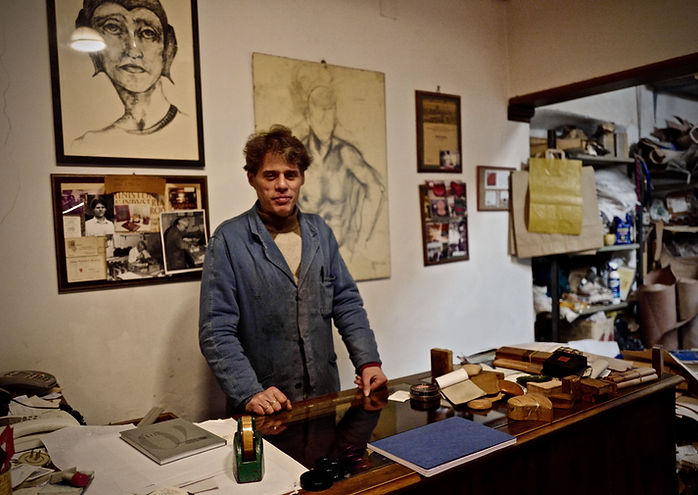
The Taddei family workshop was founded in 1937 by Simone's great-grandfather — a skilled artisan shoemaker who made men's dance shoes and was the first in the family to work with rawhide leather. The craft passed from great-grandfather to grandfather, from grandfather to father, and from father to Simone — four generations in the same tradition, in the heart of Florence, steps from the house where Dante was born.
Simone Taddei, Florence. Agnes Select Image.
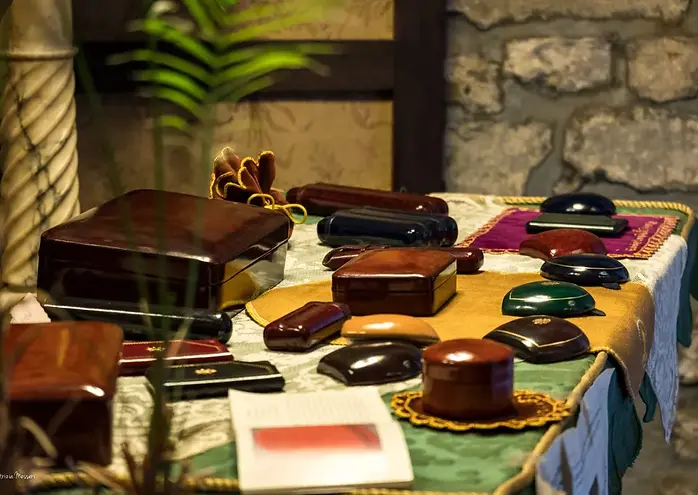
Simone works using ancient techniques to produce solid leather boxes, frames, jewellery boxes, desk accessories and moulded coin purses in traditional cuoio massello — thick leather shaped over wooden forms and worked through dozens of manual steps for each piece. Italian craft platforms describe him as one of the very last to do this kind of work entirely by hand in the historic centre. The workshop has a following in Japan as well as Europe — a quiet but telling sign of the international recognition that genuine Florentine craft continues to attract.
Every piece feels like a small heirloom — which, given that this family has been making things by hand since 1937, is exactly what it is. Coin purses and small boxes from €60; larger pieces from €150.
For current hours, visit the official Simone Taddei workshop website.
Simone Taddei, Florence. Guarda Firenze Image.
Pelletteria Artigiana Viviani
Located at Via Guelfa, 3a.
Renato Viviani began his career in the 1920s as an apprentice in the first workshop of Guccio Gucci himself — the man who would go on to build one of the most famous fashion houses in the world. When war came, Renato fled to Argentina, where he spent decades perfecting his craft and eventually became a Master Artisan in Buenos Aires. He returned to Italy in the 1950s and in 1965 opened his own workshop on Via Guelfa — in a building that had once been the studio of Giuseppe Poggi, the architect who designed Piazzale Michelangelo. The beautiful coffered ceiling dating from 1860 is still there. So is the small garden Poggi designed behind the workshop.

Pelletteria Artigiana Viviani, Florence. Pelletteria Artigiana Viviani Image.
Just two months after opening, the catastrophic flood of November 1966 swept through Florence and nearly destroyed everything. Renato rebuilt — for what felt like the hundredth time in a life that had already required starting over more than once.
Today the workshop is run by his daughter Viviana and her son Leonardo, the third generation of the family. The space looks exactly as it did when Renato opened it — cutting models for every bag ever made hanging on the walls, the large central work table where everything takes shape, the open layout that lets visitors watch the craft being practised in real time. Viviana designs every bag without computer software, the leather is cut entirely by hand, and all hides come exclusively from tanneries in Santa Croce sull'Arno. Each bag is named after a woman — a tradition started by Renato and continued to this day.
In 2015 the workshop was awarded the title of Esercizio Storico Fiorentino — Historic Florentine Establishment — by the City of Florence. One of only a handful of leather workshops to hold this distinction. Bags from €250; briefcases from €350; small goods from €70.
For current hours, visit the official Pelletteria Artigiana Viviani shop website.

Pelletteria Artigiana Viviani, Florence. Pelletteria Artigiana Viviani Image.
Dimitri Villoresi — DV Bags
Located at Via dell'Ardiglione, 22.
Dimitri Villoresi grew up in the San Niccolò neighbourhood of Florence, in the streets and hills that still underpin everything he makes. As a boy he thought he might become a professional footballer. Instead, since 1985, he has spent his life working leather between his two hands — and has built a reputation as one of Florence's finest leather designers in the process. In 2020, Dolce & Gabbana included him in their Le Botteghe di Firenze show at Palazzo Vecchio — a celebration of the city's most exceptional living artisans.

Dimitri Villoresi, Florence. Dimitri Villoresi Image.
Every stage of the work — design, cutting, stitching, finishing — is done by hand in his secluded Oltrarno workshop, using vegetable-tanned leather sourced for its quality and worked so that every inch is used. The bags are contemporary but quietly classic, made to order, built to last. He also teaches younger artisans the craft, which means the workshop carries a sense of something being deliberately passed on.
df˚ø
Ask him about his inspiration and he will tell you about La Forza — the Force, which he describes as the most important thing in the world. Roots. Sap. The earth as our mother. It sounds philosophical until you hold one of his bags and understand that he means it entirely literally: the leather comes from the earth, is worked by hand, and returns something beautiful to the person who carries it. As he puts it simply: "You will always have a good bag with you. This I guarantee with my work."
Bags from €300. Custom and made-to-order work available. To make an appointment, visit the official Dimitri Villoresi workshop Facebook page.

Dimitri Villoresi, Florence. Dimitri Villoresi Image.
Consani e Giannini
Located at Via Lorenzo Bartolini, 13.
Founded by Roberto Giannini, who started in the workshop at just sixteen, Consani e Giannini has been part of San Frediano since the height of Florentine leather craftsmanship in the 1980s, when Roberto made pieces for names like Bruno Magli, Paolo Gucci, Giorgio Armani and Valentino Garavani, exporting as far as Japan and the United States. The workshop weathered a difficult stretch after 2001, when much of that world contracted, and it was Roberto's wife Mara and their sons who kept it standing... Mara taking on the administration, Leonardo and Tommaso gradually stepping into their father's place at the workbench. Today Leonardo runs the workshop with Tommaso alongside him, and Susy, who has been there for years, still at the sewing machine.

Consani e Giannini, Florence. Consani e Giannini Image.
What the workshop makes has evolved without losing the handwork at its center. Alongside the wallets, bags, belts and small accessories they've always produced, Consani e Giannini now creates leather pieces for some of the world's top luxury hotel brands, including Four Seasons and Mandarin Oriental... menu holders, wine lists, hotel service directories, the kind of details most guests will never think to ask who made. Everything is still made entirely by hand, on the same via Bartolini workbenches, and a genuinely handmade wallet starts at around fifty euros.
What stays with you most, though, is the family themselves... warm, generous with their time, and clearly, deeply talented, the kind of people who welcome you in like you've been coming for years rather than like a customer who just wandered in. Lovely Eleonora, who I met there myself, is very much part of that warmth.
For current hours, visit the official Consani e Giannini website.

Consani e Giannini, Florence. Consani e Giannini Image.
Frau Leman
Located at Via dei Serragli 61R.
Stephanie — Frau Leman — came to Florence from Berlin, where she had spent years repairing and restoring leather goods in a craftswomen's workshop, finding in leather work the purpose and grounding that nothing else had given her. She came for an internship, stayed for over a year in a family-run Florentine workshop, and eventually opened her own small space in Santo Spirito. Five years later, she is still here — in a slightly larger workshop on Via dei Serragli, making bespoke bags, wallets, belts and accessories by hand from Italian leather sourced from Tuscan tanneries.

Frau Leman, Florence. Frau Leman Image.
Everything is made in the workshop, from design through to the final stitch — hand tools, a sewing machine and two hands. The work is quiet, considered and entirely personal, which is precisely what makes it worth finding.
Her keychains featuring Brunelleschi's dome are one of those small, perfectly conceived Florence souvenirs that manage to be both beautiful and genuinely local — the kind of thing you buy without planning to and end up keeping for years.
Bespoke slots are limited and becoming more so as her reputation grows. If you want something made specifically for you, plan ahead.
For current hours, visit the official Frau Leman workshop Instagram page.

Keychain by Frau Leman, Florence. Frau Leman Image.
Pelletteria Bruscoli dal 1881
Located at Via Montebello, 58R. Visits by appointment only — this is not a boutique and does not accept walk-ins.
Founded in 1881 as a printing and bookbinding shop, Bruscoli has been making gilded and tooled leather objects in Florence for nearly a century and a half. Today the workshop is in the hands of Minako Saito — a Japanese craftswoman who arrived in Florence in 2011 with nothing but passion, trained at the Scuola del Cuoio, and then entered the Bruscoli bottega where she became the devoted student of fourth-generation master Paolo Bruscoli. She is now his successor, the keeper of a gold decoration technique so specific and rare that only Bruscoli could do it.
What Minako creates — working entirely alone from design to finish — are leather objects decorated using a combination of over 2,000 punches and 300 wheels, building intricate gilded surfaces that are as much fine art as craft. Leather-bound books, bags, boxes, albums and decorative panels, each one unique. She describes the gold decoration technique as creating "golden time" for those who use the objects — and her broader vision, which she calls the Thread of Hope, is that this extraordinary skill will continue to connect things and people, like a sewing thread, long into the future.
For more info, visit the official Pelletteria Bruscoli workshop Instagram page.

Pelletteria Bruscoli, Florence. Kumiko Nakayama Image.
Il Merlo Bags — Kyoko Morita
Located at Via dello Sprone 9/11 R.
Kyoko Morita was born in Chicago, grew up in Nara, studied product and interior design in Kyoto, and worked across Tokyo and Hong Kong before arriving in Florence in 2013. She came to learn leather at the Scuola del Cuoio, then studied under Dimitri Villoresi — whose commitment to making high-quality bags entirely without machinery left a lasting impression. In 2015 she launched Il Merlo, first exhibiting at Villoresi's studio, then from a corner of a Florence boutique, and from 2018 from her own workshop in the city.

Il Merlo Bags, Florence. Il Merlo Bags Image.
The bags are geometric, sculptural and hand-stitched point by point — strong shapes and playful colour combinations that feel neither traditionally Florentine nor conventionally Japanese, but something entirely her own. The guiding philosophy is borrowed from the Roman architect Vitruvius: Firmitas, Utilitas, Venustas — strength, utility and beauty. It is a framework that sounds classical until you see how playfully she interprets it.
Her work has been shown at Artigianato e Palazzo in Florence and at the Umeda Hankyu Italy Fair in Osaka — where she has also held temporary workshops, building a following that spans continents in the way that genuinely original work tends to do. For readers who want something striking, considered and entirely non-touristic, this is one of the most interesting addresses in the city. Bags from approximately €350.
For current hours, visit the official Il Merlo workshop website.

Il Merlo Bags, Florence. Il Merlo Bags Image.
Fratelli Peroni — Peroni Firenze
Laboratory at Via G. Marconi, 82R.
Since 1956, the Peroni family have specialised in cuoio artistico fiorentino — an ancient technique born in Florence during the Renaissance and passed down through generations to the present day. The process is unlike anything else in the city: leather is selected, cut, wetted and mounted on wooden forms to define its shape, then left to dry so it permanently retains the form of the mould. The pieces are assembled without stitching — held together entirely by the structure of the leather itself — then coloured layer by layer from the hide's natural tone to the desired shade, and finally polished with natural wax until the surface glows.

Fratelli Peroni, Florence. Fratelli Peroni Image.
The detail that stops people when they hear it: their iconic tacco coin purse requires thirty-seven individual steps to complete. The gold decoration — applied by hand using bronze punches and wheels — is 22 karat. Every finished piece comes with two certificates attesting to its quality and origin.
Widely recognised as the reference makers of the Florentine tacco coin purse and the radica hand-coloured finish, Peroni's work bridges artisan leatherwork and small sculptural objects — trays, desk sets, boxes and bags that feel as much like craft objects as functional accessories. The workshop still operates exactly as it always has: every article made by hand, finished in every detail, in the same space where the family has worked for nearly seventy years. Small items from €40; larger pieces from €120.
For current hours, visit the official Fratelli Peroni workshop website.

Fratelli Peroni, Florence. Fratelli Peroni Image.
Ateliergk Firenze
Located at Borgo San Frediano, 133r.
Founded in 2010 by Lapo Giannini and Michiko Kuwata — two artisans born into artists' families, between them carrying six generations of family history and over twenty years of experience in bookbinding, conservation and the crafting of luxury objects. Lapo brings a deep roots in Florentine tradition; Michiko brings Japanese precision and meticulous attention to aesthetic detail. The combination produces something entirely its own.

Ateliergk Firenze, Florence. Ateliergk Firenze Image.
The atelier works across Florentine leather, gold leaf, hand-made paper and artistic bookbinding — producing objects for writing desks, custom-bound books, decorative boxes and interior pieces that sit at the intersection of craft disciplines. Every piece is made to the client's specifications, with customised decorations and finishes. The guiding philosophy is stated simply: striving for perfection and innovation without neglecting the past, creating objects intended to be preserved over the coming centuries.
In 2018, Ateliergk was selected by the Michelangelo Foundation in Switzerland as one of the Best Master Craftsmen of Europe — recognised alongside other European artists at the Homo Faber event at the Giorgio Cini Foundation in Venice. For a small Oltrarno atelier, it is an extraordinary distinction, and entirely deserved.
A wonderful address for readers who love book arts, beautiful objects and the idea of craft as something that transcends categories.
For current hours, visit the official Ateliergk workshop Instagram page.

Ateliergk Firenze, Florence. Ateliergk Firenze Image.
Beyond Florence: Leather Artisans Worth the Trip
These destinations require a trip outside the city but reward those with a serious interest in Tuscan leather traditions.
Cuoio Artistico Fiorentino (CAF)
Located in Scarperia e San Piero, Mugello — approximately 40 minutes north of Florence by car.
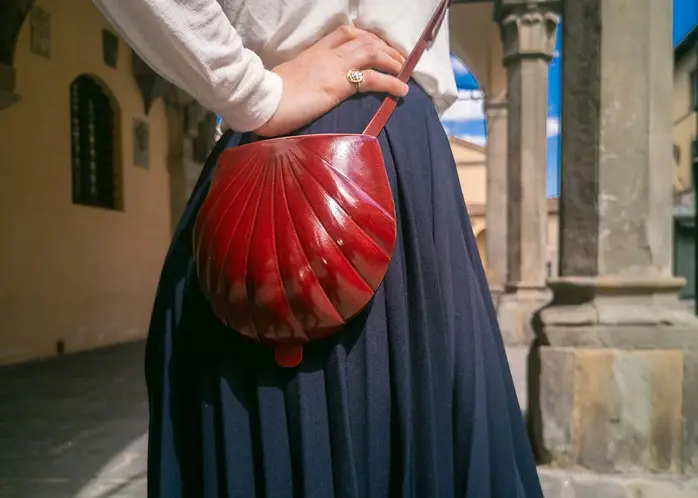
The story of CAF begins in a Florentine bottega on Via Michelangelo Buonarroti, where an eighteen-year-old Vasco Capanni began learning his craft under Master Artisan Rino Peruzzi — learning to wet and stretch the leather into shape, to colour it, to burnish and polish it by hand. By 1956 he had earned his own recognition as a Master Artisan at the Florence Craft Fair, and his work has been known internationally ever since. Today the business is run together with his son Fabio, who learned the craft directly from his father and has brought new energy and visibility to the family name.

CAF, Mugello. CAF Image.
CAF specialises in cuoio artistico fiorentino — moulded leather trays, boxes, coin purses and desk sets made in the traditional technique that has its roots in the early 20th century workshops of Florence. A good stop if you are already planning a Mugello day trip. Small gift items from around €40.
For current hours, visit the official Cuoio Artistico Fiorentino workshop website.
Venus bag by CAF, Mugello. CAF Image.
Stefano Parrini
Located in Vicchio, Mugello — a countryside day trip northeast of Florence.
Stefano Parrini was born in Florence in the early 1950s and left for Central America at eighteen — the beginning of a life shaped by travel, manual work and a growing fascination with leather. It was in Mexico and Central and South America that he first encountered the specific techniques that would define his craft. Back in Italy in the 1980s, he settled in the Apennine hills, working with coachmen and riders, learning saddlery, and gradually developing his own models — travel bags, hiking accessories and everyday objects in heavy vegetable-tanned leather, hand-sewn with waxed linen thread.

When leather fell out of fashion in the late 1980s he was forced to stop. It was only in the early 2000s, sensing a quiet revival of interest in handmade objects, that he returned — this time with a clear and uncompromising vision: everything made entirely by hand, exclusively in vegetable-tanned leather, to his own exclusive designs. Since 2017 he has been recognised as a Master Artisan by the Florence Chamber of Commerce. He also teaches in his workshop and at institutions including the Scuola del Cuoio and Accademia Riaci.
The work is serious, the aesthetic unmistakable — robust, distinctive and entirely unlike anything you will find in the city. Best approached as a dedicated craft visit rather than a quick shopping stop.
For appointments, visit the official Stefano Parrini workshop website.

Sapaf Atelier — est. 1954
Located in Scandicci at Via G. Donizetti, 26.
A third-generation family company active since 1954, producing high-end pelletteria for their own brand and for other fashion labels. Part of the wider Scandicci leather district — the industrial heart of Tuscan leather production. Worth including as context: this is how the broader tradition sustains itself commercially, behind the scenes of the luxury brands many visitors already know.
For current hours, visit the official Sapaf Atelier workshop website.

Real Craftsmen vs. Tourist-Trap Leather — Quick Answers
How can I tell if leather in Florence is real or fake?
Most items at San Lorenzo market and around Mercato Nuovo are assembled in Italy and carry a "Made in Italy" label, but are often made from pelle soffiata — a processed, expanded leather that does not breathe, does not age, and never develops the patina that real Tuscan leather acquires over years of use. Genuine leather is vegetable-tanned and cut and stitched by hand in a real workshop.
Is the leather sold at San Lorenzo market in Florence real?
Mostly not. Items there and around Mercato Nuovo are typically assembled in Italy and labelled "Made in Italy," but the material is often pelle soffiata, which does not breathe, does not age, and never develops a real patina.
Where can I buy real leather in Florence?
Genuine vegetable-tanned Tuscan leather, cut and stitched by hand, can be found at family workshops such as Clamori di Firenze, GF89 by Giuseppe Fanara, Pelletteria Artigiana Viviani and Consani e Giannini — all working in their own ateliers rather than selling mass-produced goods.
How much does handmade leather cost in Florence?
Prices vary by workshop. Small leather goods start from around €40 at GF89 and Fratelli Peroni. Bags typically start from €120 at Clamori, €220 at Furò e Punteruolo, €250 at Pelletteria Artigiana Viviani, and €300 at Dimitri Villoresi.
Which Florence leather workshop has the longest family history?
Pelletteria Artigiana Viviani, founded in 1965 by Renato Viviani — a former apprentice in Guccio Gucci's first workshop — is now run by the third generation of his family. It was awarded the title of Esercizio Storico Fiorentino (Historic Florentine Establishment) by the City of Florence in 2015.
Is there an affordable, genuinely handmade leather option in Florence?
Yes. GF89 by Giuseppe Fanara offers small leather goods from around €40, made entirely by hand from vegetable-tanned cuoietto fiorentino. Fratelli Peroni also has small items from €40, using a traditional technique passed down since 1956.
Where can I find handmade leather bags by a female artisan in Florence?
Frau Leman, run by Stephanie in Santo Spirito, makes bespoke bags, wallets, belts and accessories entirely by hand from Italian leather sourced from Tuscan tanneries. Pelletteria Artigiana Viviani is also run by women — Viviana and her son Leonardo — continuing the family's third generation of craft.
Are there leather artisans worth visiting outside Florence's city centre?
Yes. Cuoio Artistico Fiorentino (CAF) in Mugello and Stefano Parrini, also in Mugello, are both recommended as dedicated day-trip destinations for those with a serious interest in Tuscan leather traditions, working in traditional moulded and vegetable-tanned techniques.
What is cuoio artistico fiorentino?
An ancient Florentine technique, practised by makers like Fratelli Peroni and CAF, where leather is wetted and mounted on wooden forms to permanently take its shape, then coloured layer by layer and polished with natural wax — assembled without stitching, held together by the structure of the leather itself.
Continue exploring Florence
→ Florence Perfumeries & Historic Pharmacies
→ Florence Hidden Gems & Off the Beaten Path
About the author
Ana Ka is the founder of Ana's Secret Guide to Italy, a Florence-focused travel publication and 100,000-member community, writing from years of firsthand experience in Florence and Tuscany.