
What to See in Florence: Hidden Gems & Off the Beaten Path
Intimate chapels, overlooked museums and merchant homes most visitors never find — our Florence expert reveals the quieter side of the city, one hidden layer at a time.
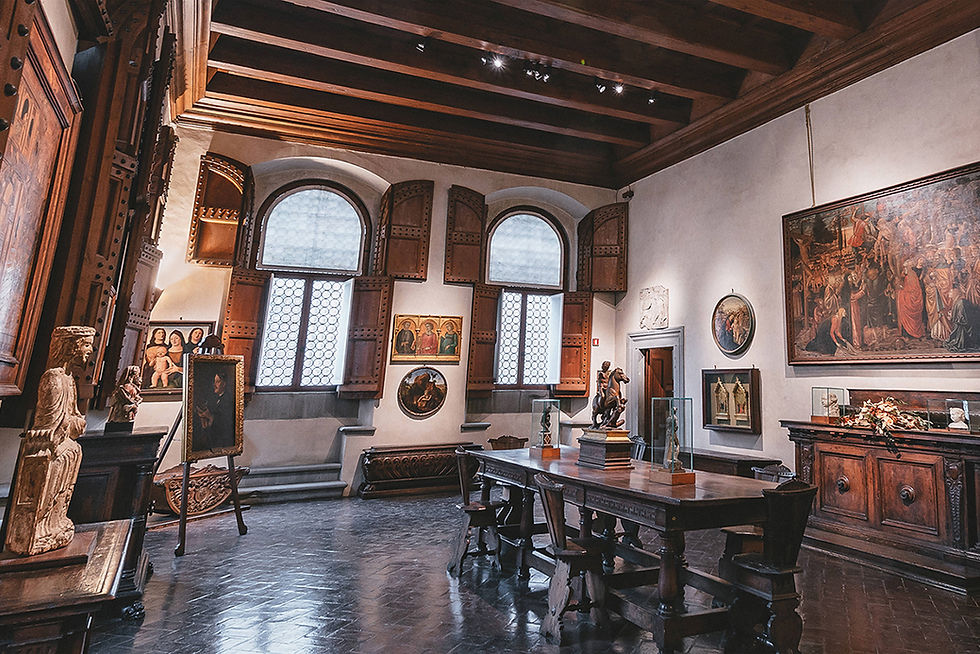
Horne Museum. Horne Museum Image.
By Ana Ka · Ana's Secret Guide to Italy
Published March 22, 2026 · Last updated June 22, 2026
Florence is more than domes and blockbuster masterpieces. Beyond the Uffizi and the Duomo lies a quieter city — intimate chapels, overlooked museums, scientific curiosities and merchant homes that reveal how Florence actually functioned. This guide gathers some of the most rewarding hidden gems in Florence for those who want depth rather than checklists.
Hidden Chapels & Fresco Masterpieces
Some of Florence's most powerful works of art are tucked inside small chapels and convent spaces. These are intimate rooms where politics, devotion and personal ambition quietly intersect.
Magi Chapel at Palazzo Medici Riccardi

Palazzo Medici Riccardi, Florence. Shutterstock Image.
Located inside Palazzo Medici Riccardi, this small private chapel was commissioned by the Medici family in the 15th century. Painted in 1459 by Benozzo Gozzoli, the fresco cycle depicts the journey of the Three Magi — but it is far more than a biblical scene.
Members of the Medici family, including a young Lorenzo il Magnifico, appear among the figures. The sacred procession becomes a political statement: a celebration of Medici influence woven seamlessly into religious narrative.

Magi Chapel, Palazzo Medici Riccardi, Florence. Palazzo Medici Riccardi Museum Image.
The room is jewel-like in scale. Gold leaf shimmers across garments, exotic animals populate the landscape, and fabrics are rendered with extraordinary precision. Because the chapel is small, you stand close to the frescoes — close enough to truly appreciate the craftsmanship.
The visit is brief, but it offers remarkable insight into how art, power and devotion intertwined in Renaissance Florence. On your way out, notice the additional frescoed room, often overlooked by visitors.
Practical Tip: While tickets are often available at the door, I highly recommend booking online in advance to guarantee your entry. For the latest information and to secure your tickets, always check the official Palazzo Medici Riccardi website.

Magi Chapel, Palazzo Medici Riccardi, Florence. Wikimedia Image.
Brancacci Chapel
Tucked inside Santa Maria del Carmine, this small but mighty chapel contains one of the most breathtaking fresco cycles in Florence — the dramatic story of St. Peter, painted with such emotional power it forever changed Renaissance art.
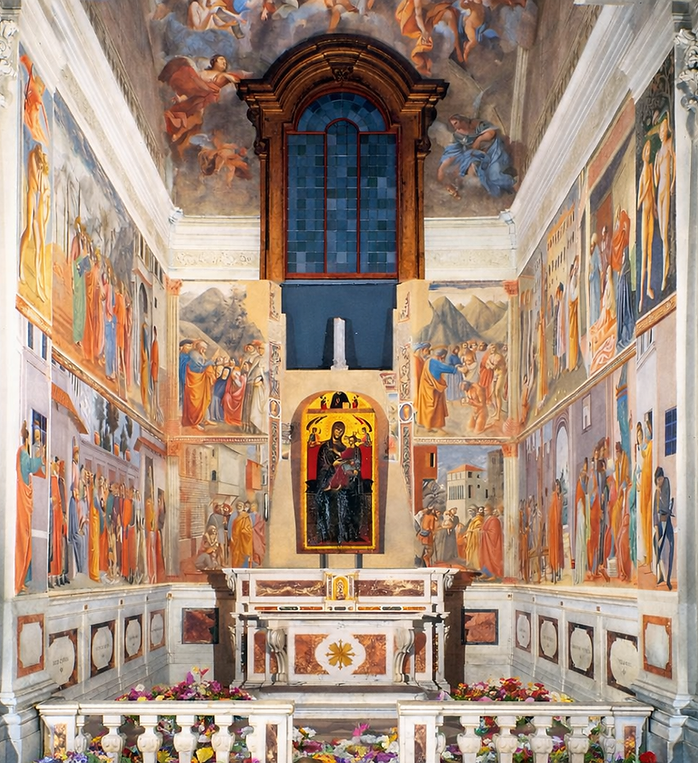
Masaccio, Brancacci Chapel fresco, Florence (1420s). Image adapted from a public-domain artwork.
Before Michelangelo astonished Rome with the Sistine Chapel, this was where young artists like Leonardo and Botticelli came to learn. Don't miss Masaccio's heart-wrenching Expulsion from Paradise — Eve's raw despair as she is cast out of Eden lingers long after you leave.

Expulsion from Paradise, Brancacci Chapel fresco, Florence. Wikimedia Image.
My favourite is The Tribute Money — almost like a Renaissance comic strip, showing three moments in one frame: the tax demand, Christ's miracle solution, and Peter retrieving the coin from the fish's mouth.

The Tribute Money, Brancacci Chapel fresco, Florence. Wikimedia Image.
Practical Tip: Look for the separate entrance to the right of the main church, and book ahead through the official Brancacci Chapel website — third-party sites always charge more.
San Marco Museum & Convent
Rebuilt in the 1430s with funding from Cosimo de' Medici, San Marco offers a quieter form of Renaissance experience.

San Marco, Florence. Shutterstock Image.
Upstairs, each monk's cell contains a fresco by Fra Angelico — painted not for spectacle, but for contemplation. The colours are soft, the gestures restrained, the architecture simple. At the top of the staircase, Fra Angelico's Annunciation remains one of Florence's most serene masterpieces — luminous and almost weightless.

Fresco by Fra Angelico, San Marco, Florence. San Marco Museum Image.
San Marco is also associated with Savonarola, the Dominican preacher who later denounced Medici excess. His small, stark cell can still be visited, adding a sobering layer of history to the space.
This is not a grand museum. It is reflective — and that is precisely its strength.

San Marco, Florence. San Marco Museum Image.
Practical Tip: Tickets are usually available at the door, though booking via the official San Marco museum website is advisable and the best place to check current opening hours.

Annunciation by Fra Angelico, San Marco, Florence. San Marco Museum Image.
Last Supper at Ognissanti by Ghirlandaio
Ghirlandaio's 1480 fresco — painted 15 years before Leonardo's version — reveals a striking medieval tradition: Judas sits isolated on our side of the table, his telltale money bag clutched in shadowed hands. This is not just artistic convention; it is theological theatre. By positioning us with Judas, Ghirlandaio forces a confrontation — we stand where the betrayer sits.
The composition hums with quiet drama. Light grazes Christ's calm profile while Judas withdraws into shadow, his face partially obscured, the purse heavy at his waist. The apostles form a protective arc around Christ, their gestures creating a subtle barrier against treachery.

Last Supper fresco by Ghirlandaio, San Salvatore in Ognissanti, Florence. Wikimedia Image.
For art lovers, those brief minutes inside become a powerful lesson in how Renaissance artists staged sacred stories. No rush, no crowds — just you, Ghirlandaio's silent tension, and the weight of that unseen silver.
Practical Tip: The site is currently temporarily closed. Even when open, it operates only twice per month, with dates announced at the end of each month on the official Ognissanti Last Supper website. Entrance is via a discreet door in the adjacent building, as access through the main church has recently been closed.
Last Supper in Sant'Appolonia by Andrea del Castagno
This Last Supper is every bit as powerful and influential as the more famous versions — and it is believed Leonardo himself studied it before painting his own in Milan.
Andrea del Castagno captures the charged moment when Christ announces, "One of you will betray me." The figures feel sculptural and monumental, set against a dramatically patterned marble backdrop. The silence inside the refectory is striking — thick enough to linger.

Last Supper fresco by Andrea del Castagno, Sant'Appolonia, Florence. Wikimedia Image.
It remains one of Florence's most overlooked treasures, with free entry and surprisingly few visitors.
Practical Tip: Opening hours can be unpredictable. Always double-check the official Sant' Appolonia Last Supper website shortly before your visit to avoid disappointment.
Chiostro dello Scalzo
Located at Via Cavour, 69.
This small, unassuming cloister on Via Cavour is one of the most quietly extraordinary spaces in Florence — and one of the least visited. Between 1509 and 1526, Andrea del Sarto painted almost the entire cycle himself, working in grisaille around the cloister walls — sixteen scenes depicting the life of St. John the Baptist, rendered with such delicacy and psychological depth that they stand among the finest fresco work of the entire Renaissance. Two scenes are attributed to his contemporary Franciabigio, who stepped in while Andrea was in France.
Grisaille — painting in shades of grey to simulate stone relief — was typically used for decorative borders or architectural details. Del Sarto used it for an entire narrative cycle, and the restraint of the technique only intensifies the emotional power of the scenes. The Dance of Salome and the Beheading of the Baptist are particularly extraordinary — intimate, almost unbearably human, painted by a man Vasari called "the faultless painter."
The cloister belonged to a confraternity of laymen known as the Scalzo — the barefoot — who used this space for private devotion. It has never been a major tourist destination, which means you will almost certainly have it to yourself. One of those rare Florence experiences that feels like a private discovery.
Practical Tip: Entry is €5. Open Monday through Saturday 8:30–13:20. Always check the official Chiostro dello Scalzo website before visiting as hours can vary.

Chiostro dello Scalzo, Florence. Chiostro dello Scalzo Image.
Florence's Overlooked Churches
Not every remarkable church in Florence announces itself loudly. These are the ones that stand quietly in the shadow of more celebrated neighbours — and reward those who stop to look properly.
Orsanmichele Church & Museum
Easy to walk past and easy to underestimate, Orsanmichele is one of Florence's most unusual buildings — and one of its most historically layered. The slightly peculiar square structure in the middle of Via dei Calzaiuoli began not as a church but as a grain market, built on the site of a monastery kitchen garden. When an image of the Madonna inside began — so Florentines believed — to perform miracles, pilgrims arrived from across Italy, and the building was gradually converted into a place of worship. The grain loggia became a church; the sacred and the commercial quietly merged.

Orsanmichele, Florence. Orsanmichele Museum Image.
In the 15th century, Florence's powerful trade guilds were each assigned a niche on the exterior and tasked with commissioning a sculpture of their patron saint. The result was an extraordinary open-air competition among the city's finest artists — Donatello, Ghiberti, Verrocchio and others all contributed works. What you see outside today are replicas; the originals are preserved upstairs in the museum, where they can be studied at close range without crowds. For those who love sculpture, that upper level is deeply rewarding.

Orsanmichele, Florence. Orsanmichele Museum Image.
Practical Tip: Check the official Orsanmichele museum website for current opening hours before visiting, as they can vary seasonally.

Orsanmichele Musem, Florence. Orsanmichele Museum Image.
San Lorenzo Church
Standing directly beside the grander Medici Chapels, San Lorenzo is easily dismissed as a secondary stop. It shouldn't be. Designed by Filippo Brunelleschi, it represents one of the most considered statements of early Renaissance architecture in Florence — not despite its apparent simplicity, but because of it. The proportions are mathematical, the columns precisely aligned, the space calm and unornamented. After the gilded excess of many Florentine interiors, that restraint feels almost radical.

San Lorenzo, Florence. Image adapted from a public-domain artwork.
The Old Sacristy, also by Brunelleschi, marks a genuine turning point in architectural history — geometry and symmetry replacing medieval decoration, space beginning to speak a new language. Long before the grand Medici Chapels were constructed behind it, San Lorenzo served as the family's spiritual base, the church where their ambitions were first given architectural form. It may not dazzle immediately — but historically, it was revolutionary. Current opening hours and entry information are available on the official San Lorenzo Church website.
_Innenraum_1_1.jpg)
San Lorenzo, Florence. San Lorenzo Church Image.
Hidden Gems in Florence: Museums & Historic Interiors
These spaces reveal how Florentines lived, collected and expressed status beyond the cathedral square
Bargello Museum
Tucked away just steps from the Florentine crowds, the Bargello occupies a former medieval prison — its stern stone walls now guarding some of the most revolutionary sculptures in art history. There is a certain atmospheric weight to the building, though personally I have always been too captivated by the art to dwell on it.

Bargello, Florence. Bargello Museum Image.
Here you can meet Donatello's David — the original elegant bronze that broke all the rules as the first free-standing nude since antiquity, his confident pose forever changing what sculpture could be. Don't miss Ammanati's Leda and the Swan, a daring and sensuous marble derived from a now-lost Michelangelo design.
But the Bargello is far more than any single masterpiece. Its rooms are filled with breathtaking terracotta works by the della Robbia family, gorgeous frescoes, and deeply moving pieces like the Madonna della Misericordia — a Byzantine-inspired image of the Virgin sheltering worshippers beneath her cloak that became a symbol of hope during the Black Death. There is also a fascinating collection of Renaissance objects: intricate caskets, scientific instruments, delicate fans and devotional statuettes that together tell the story of a city that was curious, vain and deeply devout in equal measure.

Bargello, Florence. Bargello Museum Image.
When the rooms begin to feel overwhelming, step into the sun-drenched courtyard. Flooded with light and open to the sky, it feels entirely at odds with the building's origins — which is precisely what makes it so memorable.
Practical Tip: Tickets can be purchased at the entrance. Check the official Bargello museum website for current opening hours before your visit.
Palazzo Davanzati
Almost everyone walks past Palazzo Davanzati without a second glance — and that is precisely what makes it one of Florence's most rewarding discoveries. No world-famous masterpieces, no grand royal apartments. Instead, something rarer: an intact 14th-century merchant home that offers a genuine window into how Florence's wealthy trading families actually lived.

Palazzo Davanzati, Florence. Image adapted from a public-domain artwork.
Built by the Davizzi family — prosperous wool and silk merchants — and later acquired by the Davanzati, a dynasty of bankers and scholars, the palazzo has survived remarkably intact. Walking through its rooms feels less like visiting a museum and more like entering a home frozen in time. The grand courtyard with its ancient well sets the tone; upstairs, lavishly frescoed bedchambers painted with peacocks and parrots, a dining room arranged for a Renaissance feast, and surprisingly sophisticated plumbing reveal a household that was wealthy, cultured, and quietly inventive.

Palazzo Davanzati, Florence. Palazzo Davanzati Museum Image.
The Sala dei Pappagalli — its walls painted with playful parrots amid trompe l'oeil tapestries — is one of the most charming interiors in Florence. The bedroom of the Castellana di Vergy tells a tragic medieval love story through its frescoes. The kitchen, positioned at the very top of the building, was deliberately placed there to keep fire, smoke and cooking smells away from the family's living quarters below — a detail that says much about Renaissance domestic thinking.

Palazzo Davanzati, Florence. Palazzo Davanzati Museum Image.
This is not a museum of great art. It is a museum of everyday life — and for that reason, it is irreplaceable. Current opening hours and entry information are available on the official Palazzo Davanzati website.

Palazzo Davanzati, Florence. Palazzo Davanzati Museum Image.
Casa Martelli
Located at Via Zannetti, 8.
One of Florence's best-kept secrets — and one of its most touching. Casa Martelli is one of Florence's only noble family homes to have survived essentially intact — an authentic, unreconstructed house-museum that feels entirely different from the city's grand institutional galleries. The last Martelli heir died in 1986, leaving the palace to the Church. The Italian State acquired it in the late 1990s and, after careful restoration, opened it to the public in 2009.
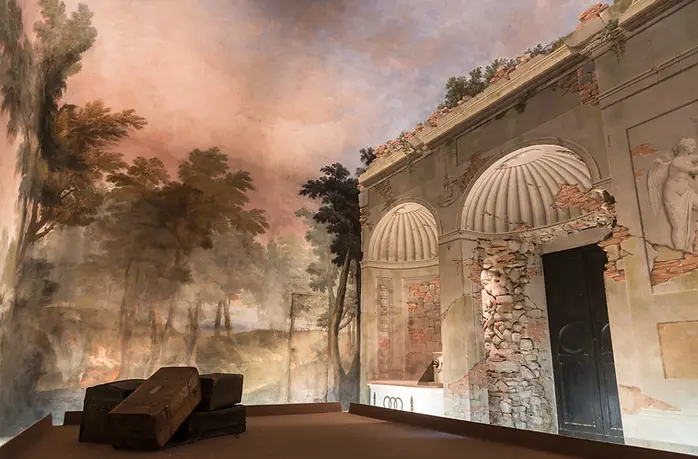
Casa Martelli, Florence. Casa Martelli Image.
The rooms are arranged much as they were in the 18th century — paintings stacked floor to ceiling in the Florentine tradition, furniture in its original position, personal objects still on the shelves. The collection includes works by Piero di Cosimo, Beccafumi and Salvator Rosa, alongside porcelain, silver and the kind of domestic accumulation that no museum could artificially recreate. It feels less like a gallery and more like a home whose owners simply stepped out.

Casa Martelli, Florence. Casa Martelli Image.
The Martelli were closely connected to the Medici for generations — patrons, allies, and neighbours in the same tight web of Florentine power and culture. That history runs quietly through every room.
Visits are by guided tour only, which in this case is a genuine advantage — the guides bring the family's story to life in a way that transforms the experience entirely.
Practical Tip: Currently closed for works from 10 March to 30 June 2026. When open, visits are on Tuesdays and Saturdays only, by guided tour in small groups. Booking is essential and must be made by phone on +39 055 0649420. Always check the official Casa Martelli website before your visit to confirm current hours and availability.

Casa Martelli, Florence. Casa Martelli Image.
Beyond the Renaissance: Science, Collectors & Eccentric Florence
Florence's story did not end in 1500. While the Renaissance defines the city's skyline and identity, later centuries added new layers — scientific curiosity, Enlightenment inquiry, aristocratic collecting, and even global fashion. These museums reveal a Florence that continued to experiment, catalogue, preserve and reinterpret its own past.
Museo Galileo
Florence's identity is built on painting and sculpture — but this museum offers a necessary corrective. Dedicated to the history of science, Museo Galileo houses telescopes attributed to Galileo himself alongside Medici-owned globes, astrolabes, surgical instruments and intricate measuring devices that together tell a different story about the city: not just a place of artists, but of empiricists, mathematicians and astronomers who were equally reshaping the world.

Museo Galileo, Florence. Museo Galileo Image.

Museo Galileo, Florence. Museo Galileo Image.
Practical Tip: One of Florence's least crowded yet most intellectually rewarding spaces. Check the official Galileo museum website for current opening hours.
La Specola
Founded in 1775, La Specola is one of Europe's oldest scientific museums — and one of its most quietly unsettling. Its collection of anatomical wax models, created for medical study in the 18th century, is astonishingly precise: muscles and tissue rendered with sculptural detail, expressions left strangely serene despite the clinical dissection on display. They are at once beautiful and deeply strange, occupying an uneasy space between art and science that feels entirely Florentine.

La Specola, Florence. Image adapted from a public-domain artwork.
Beyond anatomy, zoological specimens and Enlightenment-era scientific instruments reflect the same encyclopaedic curiosity that drove the Renaissance — the desire to observe, catalogue and understand the natural world in its entirety. Less polished than Florence's major institutions, La Specola has the character of a place that has never tried too hard to be anything other than what it is. Current opening hours and entry information are available on the official La Specola museum website.
Stibbert Museum
Frederick Stibbert was an Anglo-Italian heir with vast resources, boundless curiosity, and no apparent desire to edit his collection. The result is one of the most eccentric and compelling museums in Italy — a hillside villa transformed into a kaleidoscope of armour, decorative arts and historical objects from across five centuries and three continents.

Stibbert Museum, Florence. Stibbert Museum Image.
The Hall of European Armour is the centrepiece: sixteen fully suited knights on horseback, posed mid-charge in a scene that feels more theatrical tableau than museum display. The rooms that follow move between Ottoman kaftans, samurai swords, Renaissance tapestries, Meiji-era lacquerware and Baroque paintings — a collection that reflects the tastes of a man who collected instinctively rather than systematically, and was all the more interesting for it. Stibbert himself is buried on the grounds, which feels entirely appropriate.

Stibbert Museum, Florence. Stibbert Museum Image.
Outside, the gardens — free to enter — are punctuated by follies, fake medieval ruins and a swan-filled pond. Barely visited even in high season, this is Florence at its most idiosyncratic.
Practical Tip: The museum is cash only and requires a taxi or longer walk to reach. Check opening hours carefully in advance as they can be limited — details on the official Stibbert museum website.
Museo Stefano Bardini
Formerly the home of Stefano Bardini — one of the most influential art dealers of the late 19th century — this museum retains his idiosyncratic display philosophy, including the distinctive deep-blue walls he used to set off his collection. Sculptures, furniture, carpets and architectural fragments are arranged not chronologically but according to aesthetic instinct, offering a rare insight into how Renaissance art was acquired, displayed and sold to international collectors during the period when Florence's artistic patrimony was most actively dispersed. A thoughtful and undervisited space. Current opening hours and entry information are available on the official Stefano Bardini museum website.

Museo Stefano Bardini, Florence. Museo Stefano Bardini Image.
Museo Horne
Created by English collector Herbert Horne and housed in a modest Renaissance palazzo, this small museum presents paintings, drawings and domestic objects arranged as they might have appeared in a cultivated Florentine home. Intimate in scale, rarely crowded, and free of the theatrical staging of larger institutions, it offers a domestic counterpoint to Florence's monumental museums — a reminder that the Renaissance was also lived at human scale, in rooms not unlike these. Current opening hours and entry information are available on the official Horne museum website.

Museo Horne, Florence. Museo Horne Image.
Hidden Gems Quick Answers — Skip the Crowds
What is the most overlooked Last Supper fresco in Florence?
The Last Supper by Andrea del Castagno in Sant'Apollonia is described as one of Florence's most overlooked treasures, with free entry and surprisingly few visitors — it is believed Leonardo himself studied it before painting his own version in Milan.
Which Florence cloister is one of the least visited?
Chiostro dello Scalzo on Via Cavour is described as one of the most quietly extraordinary spaces in Florence and one of the least visited, with an entire fresco cycle by Andrea del Sarto. It has never been a major tourist destination, so visitors will almost certainly have it to themselves.
Is there a museum in Florence showing how wealthy Florentines actually lived, rather than just art?
Yes — Palazzo Davanzati, an intact 14th-century merchant home, offers a genuine window into how Florence's wealthy trading families lived, with frescoed bedchambers, a Renaissance dining room and surprisingly sophisticated plumbing. It is described as "not a museum of great art" but "a museum of everyday life."
What is one of Florence's best-kept secret museums?
Casa Martelli, a noble family home that survived essentially intact, is described as one of Florence's best-kept secrets. It opened to the public only in 2009, and visits are by guided tour only, in small groups.
Where can I see Donatello's original David in Florence?
The original bronze David by Donatello is in the Bargello Museum — described as the first free-standing nude since antiquity.
Is there an unusual or eccentric museum in Florence beyond the typical art museums?
Yes — the Stibbert Museum, a hillside villa housing armour, decorative arts and historical objects from five centuries and three continents, including a Hall of European Armour with sixteen fully suited knights on horseback. It is described as barely visited even in high season.
Explore Florence with an Expert
For those who want to go deeper, I curate a small number of private tours led by art historians and scholars I genuinely trust — people I have met over years of research and through the creation of the AppyGuide audio stories. These are conversation-based experiences, led by experts who continue to publish and lecture. Availability is limited and advance booking is advisable.
Prefer to explore at your own pace? The AppyGuide audio stories are a good place to start.
If it’s your first time in Florence…
Start with the city’s main landmarks — they provide the context that makes these quieter places even more meaningful.
About the author
Ana Ka is the founder of Ana's Secret Guide to Italy, a Florence-focused travel publication and 100,000-member community, writing from years of firsthand experience in Florence and Tuscany.